
6.5 KiB
👁️ ToolBox — the digital phone booth (cabine numérique)
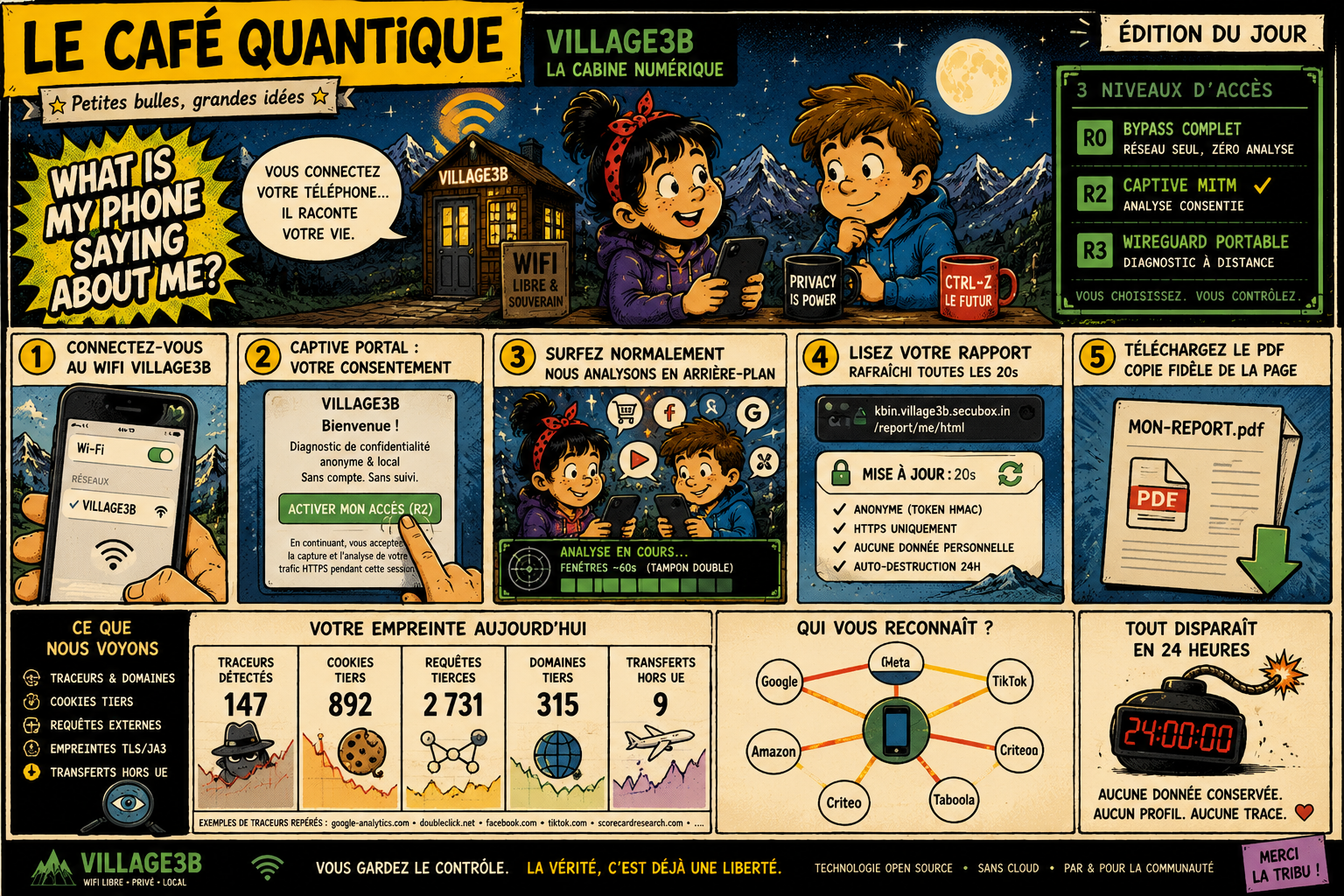
🟣 MIND · 🟡 WALL — a public SecuBox access point that shows any passer-by, in plain language, exactly what their phone leaks on the network — then hands them an ephemeral, anonymous report they can keep.
The ToolBox is a self-contained cabine numérique: an open Wi-Fi SSID
(e.g. VILLAGE3B) on an isolated sandbox subnet, a captive portal with
explicit R2 consent, a transparent MITM inspection pipeline, and a live
privacy report served at kbin.<board>.secubox.in. Nothing is tied to a
real identity — the client MAC is hashed with a daily-rotating salt and all data
expires within 24 h.
- Package:
secubox-toolbox· FastAPI/Uvicorn portal on:8088 - Companion app: Android-ToolBox 📱 one-tap R3 onboarding
- Doctrine: OPAD + R2-consented egress (CSPN) — no TLS-break without opt-in
Use case — "what is my phone saying about me?"
- Connect to the open
VILLAGE3BSSID. The captive portal greets you. - Consent (R2) — one tap "Activer mon accès" is the logged opt-in. Without it, traffic is relayed but not decrypted.
- Surf normally. The cabine classifies your egress (trackers, DPI, cookies, TLS fingerprints) in the background — double-buffered, ~60 s windows.
- Read your report —
kbin.<board>.secubox.in/report/me/html, refreshed every 20 s, or download the PDF (a faithful copy of the web page). - Everything self-destructs within 24 h. The report link is an anonymous HMAC-sealed token.
Typical settings: a maker-space, a library, a festival stand, a classroom — a place where people can see surveillance capitalism happening on their own device, with no account and no tracking of their own.
Protection levels (R0 → R3)
| Level | Name | What it does |
|---|---|---|
| R0 | 🌐 Open | No analysis. Plain relay. |
| R1 | 🛡 Passive | Passive analysis, no banner (recommended default). |
| R2 | 🔍 Consented | Analysis + in-page transparency banner (explicit TLS-break). |
| R3 | 🧅 Tunnel | Full WireGuard tunnel (wg-toolbox) — mobile clients onboard via the app; the DPI engine sees real egress + media. |
The report's 🔀 Mon niveau de protection card lets the visitor switch level live.
The report — Mon rapport
The report is the heart of the ToolBox. Same data model in the live HTML page and the downloadable PDF — the PDF is a faithful mirror, not a stripped-down export. Three tabs: 🍪 Pistage, 🛰️ DPI-Exfil, 🌍 Overall.
🎮 Netrunner character sheet
A cyberpunk fiche de personnage that maps the visitor's live telemetry onto RPG stats — the friendly face of the analysis:
- ⚡ Caractéristiques — DÉFENSE / DISCRÉTION / RIPOSTE / INTEL, each shown as
pips
●●●○○○with a value and a note (e.g. "312 pubs tuées", "4 cat · 27 flux"). - 🎒 Inventaire · protections — active defences as ✓/✗ chips (Tor tunnel, MITM cert, WireGuard R3, ad-blocker).
- 🐉 Bestiaire · qui te traque — the top trackers following you across sites.
- ⚔️ Quêtes en cours · menaces — live threats from the DPI engine, each with
its destination and detail (e.g.
🗡️ NEW CLOUD — AWS S3 · première sortie,🗡️ BEACONING — Google LLC · 15 flux périodiques (~26.9 s)), or a "zone sûre" all-clear. - 🧬 ICE / Exposition / XP bars summarise integrity, exposure (0–100), and the volume exchanged over 7 days.
🍪 Pistage
Verdict-first exposure gauge (0–100) plus En un coup d'œil: a trackers donut,
a countries bar chart (where your data goes), and a most-tracked-sites chart.
Deep-technical cards (compromise scoring, threat-intel / DGA / beaconing, contacted
hosts, cookie providers, device fingerprint, cert-pinned apps, inspection
transparency) are collapsed into <details>.
🛰️ DPI-Exfil — this device's egress (R3)
Four donuts of what this device sends out over the tunnel, classified by the DPI engine: service categories (☁️ cloud / 📦 file-host / 💬 messaging / 🤖 AI / 🎬 media / …), protocols, exfiltration alerts, and top destinations, plus KPIs (flows, ⬆️ Mo sent, ⬇️ Mo received, alerts).
🎬 Media types captured
Two complementary views, deliberately distinct:
- Service category
media— streaming services recognised by SNI (Netflix, YouTube, Spotify…), inside the DPI categories donut. - Captured MIME types — the real
Content-Typethe MITM sees in R4/analyst mode (📺 video / 🎵 audio / 🎞️ HLS·DASH manifests / ▶️ video pages), with a top-hosts table. Populated once you browse a video/audio through the tunnel.
🌍 Overall
The same four DPI donuts aggregated board-wide (all devices behind R3) — for spotting anomalous usage at the network scale.
Endpoints (public, anonymous)
| Method | Path | Description |
|---|---|---|
| GET | /report/me/html |
Live HTML report (?mh=<hash> for R3/remote clients) |
| GET | /report/me |
Same report as a PDF |
| GET | /report/{token} |
HMAC-sealed ephemeral PDF (24 h) |
| POST | /change-level |
Switch R0/R1/R2 |
| GET | /wg/toolbox.apk |
Android companion (see Android-ToolBox) |
All report rendering runs off the event loop, serialized, and short-cached, so a heavy PDF (or a retry storm) can never wedge the portal.
Privacy & retention guarantees
- MAC hashing with a daily-rotating salt — no session ↔ identity mapping kept.
- R2 = explicit consent only — the opt-in click is the logged proof; no consent, no TLS-break.
- TLS-break only on the captive subnet (
10.99.0.0/24) — the rest of the LAN is untouched. - 24 h retention — hashes, events, and report links all expire; raw logs are dropped at session end.
- Open by default — no ads, no resale; a digital commons (CyberMind / Gérald Kerma, Savoie).
See also
- Android-ToolBox — one-tap R3 onboarding companion
- Anti-Track — the tracker blocking / poisoning / anonymisation engine
- Browser-Extension — desktop social-graph cartography
- Architecture — where the ToolBox sits in the six-module stack